
By Jake Kramer
This summer we rebuilt our own website. Even though our team has been building websites for other people since 2006 (and I personally have now launched 725 websites in my career) it was still a process. However, for the first time, AI was in the room for the whole thing.
So here’s the behind-the-scenes. Where it saved me actual days. Where it faceplanted. And why the most important sentence on the entire site still had to come from a human brain.
The first draft was a corporate stranger
Early on, I did the thing everyone does. Opened a chat window and said: take a swing at our homepage.
It came back instantly. Confident. Polished. Grammatically perfect.
And it read like every agency website you’ve ever clicked away from in four seconds. Something about elevating brands and amplifying digital presence. Words that sound like marketing and mean nothing.
Lesson one, and it took me a while to really absorb it cause it seems so simple: without context, AI gives you the first generic thing. It writes what a website usually says. Statistically average copy, delivered with total confidence.
It reminds me of this cartoon:
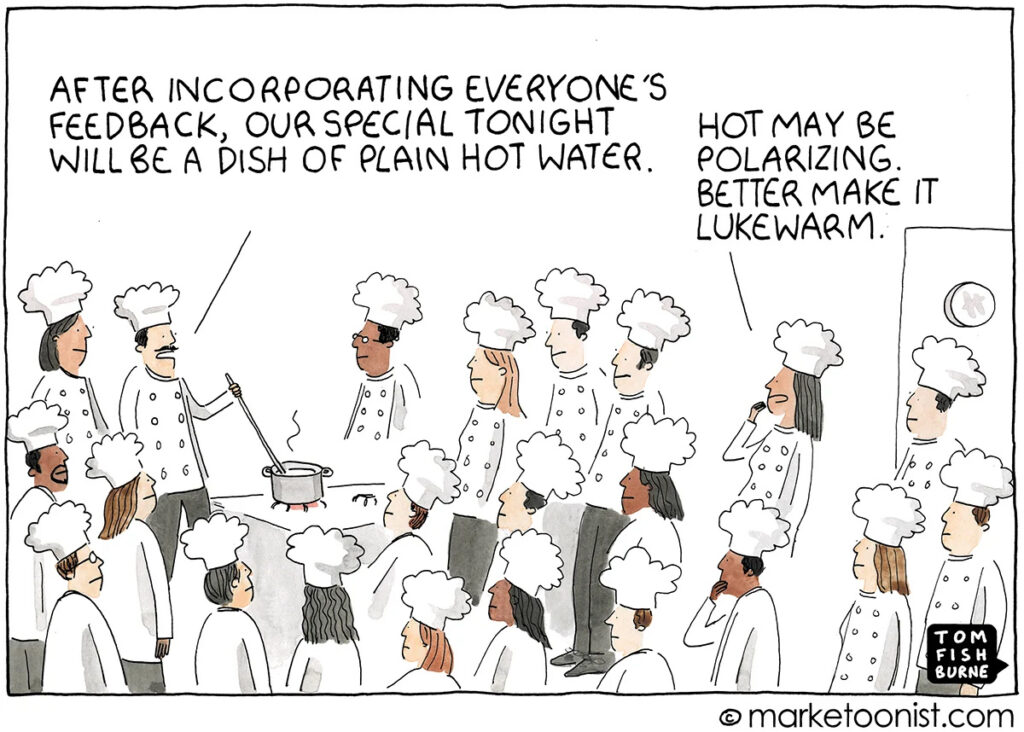
You can’t prompt your way past that in one clever line. AI is like a room full of experts. That can be good, or it can be too many chefs in the kitchen. And once you accept it, it tells you exactly how to use the thing well. More on that in a minute.
Where it saved me actual days
Credit where it’s due, because the time savings were real. The pattern: AI is at its best on work that’s tedious, repetitive, and easy to check.
- SEO audits. Crawling the whole site, flagging weak page titles, missing descriptions, thin pages. That used to mean a spreadsheet and a lost afternoon. Now: minutes.
- The nitty-gritty details. Alt text on every image. Metadata on every page. The redirect map from the old site to the new one, so 20 years of links don’t break. This is the invisible plumbing that Google cares about and humans dread. AI drafted all of it. I reviewed all of it.
- Image prep. Resizing and renaming a whole folder of photos for the web. Gone from my calendar.
- Reports. Pulling data and turning it into something a human wants to read used to be its own little project. Now it’s minutes.
- Forms. This one surprised me most. Building the form, writing the field descriptions, titling everything, setting up the confirmation messages and the notification emails. That flow used to eat an afternoon per form. It continues to be a lifesaver on every single project.
- Basic edits. Swap this text. Replace that image. Run a search-and-replace across the site. Small jobs that used to take real brain power, because one slip breaks something.
Add it all up, and that’s days of my working life back. On one project. I’m not going back!
Where it faceplanted
Two stories.
The technical one. During a content migration, AI moved a batch of blog posts to a new site and everything looked perfect. Except the images inside those posts were secretly still loading from the old domain. The day the old site went dark, every one of them would have broken!
Nothing looked wrong until you knew exactly where to look. That’s the danger with AI and technical work: it fails politely. If you don’t know what right looks like, you won’t catch wrong. You gotta have someone (human) who knows what “good” actually is check the output.
The bigger one: voice. This is where AI gets it wrong the most, and where I’d wave the biggest caution flag for any business owner. AI writing sounds professional. Professional is not the same as yours. Every first draft came back sounding like a stranger doing an impression of us. Same with design! Without context, the same slop “too-many-chefs-in-the-kitchen” slop.
You’ve got two options here. Spend real effort fine-tuning it on how you actually talk. Or treat the first draft as structure only. Bones, not skin. Hop in, keep the skeleton, and rewrite the words until they sound like something you’d say out loud.
I did a lot of both. There’s no third option where you skip the work.
The sentence AI couldn’t write
Now the fun part 🙂
The most important sentence on our website is three (or technically I guess it’s four?) words:
Trust at First Site.
That headline was 100% human brain, and I want to walk through where it came from. The process is the point.
I’d been studying how the big brands write headlines. The best ones are simple and carry a double meaning. My favorite example: GoDaddy built a whole campaign site with its own AI tools to sell others to use the AI tools. The headline example (you’ve probably seen it) is Walton Goggins designer goggle glasses, and the headline is “Strap in. Look out.” Four words, two meanings. It’s enticing, it summarizes the product, and it opens a story loop you want to keep pulling on.
I wanted that for us. We’re in the trust business. People come to us because the website they have doesn’t match the reputation they’ve earned in person. So I started with “trust at first sight.”
Close. But ordinary.
Then it clicked. Site.
One letter, and now the headline says what we make, what it does, and winks at you on the way by.
No prompt produced that. It came from years of knowing our customers, weeks of noticing patterns in other brands, and one small human moment where two ideas touched.
That’s why story still matters. Your homepage has about two seconds to answer three questions:
- What do you do?
- How does it make my life better?
- What do I click?
AI doesn’t know your answers. You do. And generic doesn’t build trust, and trust is the entire job.
Then hand it the megaphone
Here’s where it flips!
Once the story exists, AI becomes the best distribution system for it I’ve ever seen. The rule I’ve landed on: the more you can profile the business, the better the output gets. Every real input raises the floor of every draft. Your story. Your customers’ actual words. Your reviews. Your interviews. Data from visitors/customers. Feed it all in.
At our agency, we now write the story down first, in one deep document, before a word of copy gets written. Who the customer is. What we promise. How we talk and how we don’t. The exact phrases real customers use. That document is what the AI works from.
Best recent example: we’re building a website for an author right now. Before drafting anything, we had AI read four of his books, plus his interviews, plus everything else we’d gathered. The drafts that came out the other side didn’t sound like a website. They sounded like him.
And once the story is captured, AI can carry it everywhere you’d never have the hours to reach. Page fourteen. The FAQ. The alt text. The form confirmations. The follow-up emails. Same voice, every corner, and it never gets tired.
Story, stakes, voice, promise: that part is yours. The reach is where AI earns its keep.
The short version
AI is an amplifier. It multiplies whatever you feed it.
Feed it nothing? It multiplies generic lukewarm water. Congrats, you get the corporate stranger.
Feed it a real story, one only you could tell? It carries that story into every corner of your website, in your voice, and stays consistent.
So use the tool. Just don’t ask it to do the one thing it can’t: know who you are.
Write that part yourself. Then hand it the megaphone.
 Jake Kramer is co-owner of Artillery Media, a web design and hosting agency in Lincoln, Nebraska that has built websites people trust since 2006.