
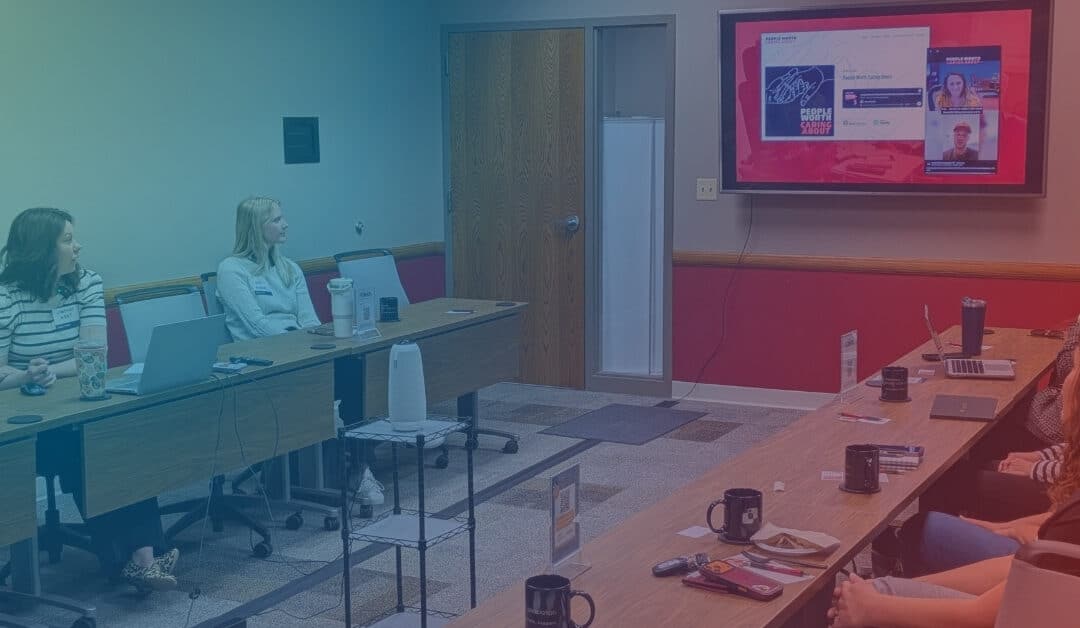
Pull up a chair. We’ve got a story to tell.
Once upon a time, there was an industry that changed lives every single day — and almost nobody knew it.
Not because the stories weren’t there. They were everywhere. They just weren’t being told. So how can strategic storytelling reshape the way your industry is perceived? That’s where Lindsay Kant comes in.
Meet Our Roundtable Host
Lindsay is Director of Membership for the Nebraska Healthcare Association (NHA), the umbrella organization representing nearly 400 nonprofit and proprietary nursing homes and assisted living communities across Nebraska. She joined us at NHA’s home base for a candid, laugh-filled, genuinely moving conversation about what it takes to reshape the way an entire industry is perceived.
Spoiler: it involves a documentary with a South American reality TV star, a cake-baking moment that made Lindsay audibly gasp, and a few lessons every marketer in the room walked away thinking about.
The Problem With “Nursing Home
Lindsay kicked things off by doing what great storytellers do: she made the room uncomfortable first.
With a quick word cloud exercise, she asked the group: What comes to mind when you hear “nursing home”?
The results? A familiar mix. Smelly. Old. Death. Outdated. But also: Caring. Dignified. Skilled. Community.
The perception problem wasn’t that people hated nursing homes. It was that roughly half of people surveyed had never set foot in one and had already formed an opinion. When you’ve never seen something, you fill in the blanks with whatever the culture hands you. And the culture, as Lindsay put it, predominantly had handed people fear.
That’s a marketing problem. Which means it’s also a marketing opportunity.
The Idea Nobody Thought Would Work
A few years ago, facing a historic workforce shortage that COVID had made dramatically worse, Lindsay’s team asked themselves a wild question: What if we just…showed people?
Not a polished brand video. Not a stock-photo campaign. A documentary.
They reached out to Peter Murphy Lewis — a licensed CNA, podcast host, and (yes, really) South American reality TV personality in the vein of Dirty Jobs — and pitched him the concept. Peter was in.
What started as a 30- to 40-minute film became a seven-episode docuseries called People Worth Caring About, each episode following Peter as he worked alongside staff at a different Nebraska member facility. Activities directors. CNAs. Physical therapists. Dietary workers. Real people, real shifts, zero scripts.
“We never would have shown that had we staged it,” Lindsay said, referring to the moment an activities director named Cheryl, mid-cake-baking session with a resident named Myrna, casually handed Peter a bite. From her fork. On camera. “That’s perfect,” Lindsay thought, watching the footage for the first time. “Also, that’s an infection prevention nightmare. But it’s perfect.”
That’s the thing about authentic storytelling. You can’t manufacture it. Sometimes, you just need to get out of your own way.
What the Room Took from It
The conversation that followed was exactly what a good roundtable should be. People riffed, connected dots back to their own work and got a little inspired. A few moments that stuck:
- On dignity: One attendee watched the cake clip and her first word was dignity. “We forget that retired folks are adults who can make their own decisions,” she said. Myrna could have been a baker. The activities director knew that. The camera caught it. That’s the whole story, right there.
- On the C-suite gap: The group got honest about the eternal tension between authentic storytelling and nervous executives. The customers, not the lawyers approving the script, are the ones making the purchasing decisions. Earning internal trust before you hit publish is, as one person put it, “the tough bit.” But tracking results and showing ROI is what turns non-believers into allies.
- On finding your own “Cheryl”: Lindsay asked everyone to flip over their table card and write down one person – a client, a customer, an employee – who could tell their organization’s story. Because before that camera showed up, Cheryl almost certainly didn’t think of herself as a storyteller. She just talked about her job. And it was everything.
The Repurpose Machine
Lindsay also walked through how a single documentary became a content engine that’s still running two years later.
- Long form: Seven full episodes on YouTube and streaming on Roku and Amazon
- Short reels: Clipped for social media, optimized for specific moments
- Geofencing: Targeted ads around the State Capitol when bills affecting NHA members were up for debate
- Education: The UNO Department of Gerontology now uses the series in their curriculum
- Media hooks: Instead of blasting a generic press release, Lindsay started connecting episodes to news hooks about local events related to people and topics in the show
- Podcast: People Worth Caring About launched as a companion show, co-hosted by Peter and NHA’s president and CEO, Jaylene Carpenter
The Takeaway You Can Use Today
Whether you’re marketing a nonprofit, an association, a small business or a brand that’s fighting an uphill perception battle, Lindsay’s project is a masterclass in one thing: trust the story enough to let it be real.
A huge thank you to Lindsay Kant and Nebraska Healthcare Association for hosting us and sharing this incredible project. Want to watch the series? Search “People Worth Caring About” on YouTube — and don’t skip the Wakefield episode. You’ll know why.
Stay connected with AMA Lincoln for upcoming events!
- April 21 – Mix & Mingle with PRSSA
- April 30 – Coffee Happy Hour @Stories
- May 7 – Prism Awards
- May 28 – Coffee Happy Hour @ Cultiva East Campus